
The first time I saw them perform, I was standing at the wrong end of RIAT. Not wrong in any official sense, just wrong for my purposes, which is to say I was further from the crowd line than I wanted to be and closer to a pair of uniformed American PR handlers than was comfortable for anyone who wanted to form their own opinion.
That was the first thing the press release had not mentioned. The team travels with people whose job is to ensure that what you take away from the day aligns with what the press release said you would take away. Display teams have press officers; this is not unusual. What was unusual, at least from where I was standing, was the density of the operation: the handlers, the cordon around the aircraft, the carefully positioned media opportunities, the way spontaneous access to anything was so thoroughly managed that spontaneity had been, for all practical purposes, retired for the afternoon.
The flying, when it came, was genuinely extraordinary. I am not going to pretend otherwise, because that would be dishonest in a different direction. The Blue Angels at close range are a serious thing. The noise alone has a physical quality that avgas smell and flat Surrey light and Merlin engines cannot prepare you for, because what they do in formation at low altitude bypasses the part of your brain still treating this as an airshow and goes directly to the part dealing with imminent threat. The crowd around me reacted in a way I recognised: that particular flinching stillness that good low-level fast jet work produces in people who did not expect to feel it.
But here is what the press release does not tell you, and what I have been thinking about since.
A Blue Angels appearance is a US Navy recruitment event. This is not a criticism. It is a fact, stated in their own documentation if you look at the right pages. The team exists to generate positive perception of the Navy and to encourage enlistment. The display is the mechanism. The crowd is the audience for a message that has nothing to do with aviation history, nothing to do with celebrating flight, and nothing to do with whatever the local airshow existed to do before the announcement landed.
That is a different thing from what British display culture, at its best, is trying to be. When I stand at the fence at Redhill on a quiet Tuesday morning and watch something interesting taxi past, or when I drive to a small fly-in somewhere in the Midlands that drew three hundred people and a man selling tea from a caravan, the transaction is between me and the flying, and nothing else is being sold. When a team with handlers and a security cordon and a fifteen-point media protocol arrives, the transaction has changed, and the press release is not going to tell you that.
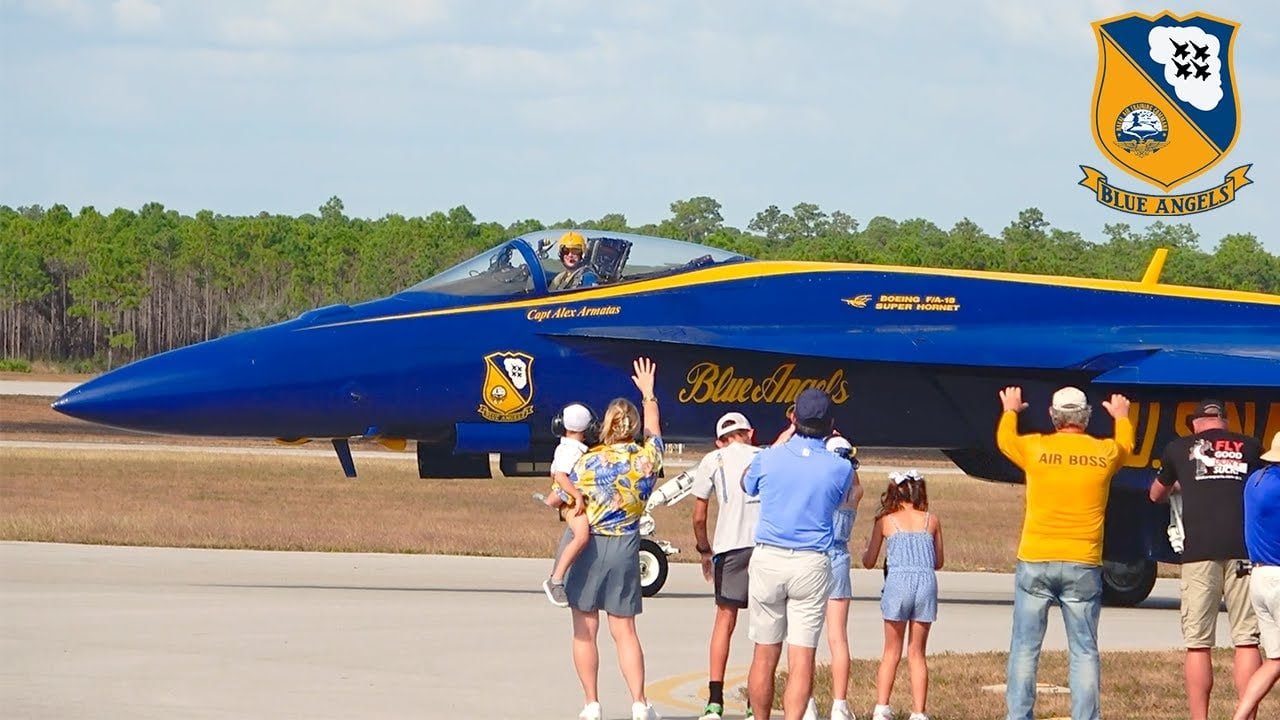
The moment that clarified this for me was not at RIAT but at a smaller event, an American municipal airshow where I spent a weekend some years ago. The Blue Angels were the reason half the town had come and also the reason half the programme had been quietly compressed to accommodate them. I spoke to one of the local organisers late in the afternoon, the kind of conversation that only happens with someone tired enough to stop being careful. She told me that the six months of logistics leading up to the appearance had consumed more of the committee’s resource than the previous three years of events combined. The airspace requirements, the security coordination, the sponsor obligations, the media management. She did not say she regretted it. She also did not say it had been worth it in the way she had expected.
The show she ran before the Blue Angels came was something specific to that town: a few warbirds, a local flying club, a display team that had been coming for a decade and knew the site by heart. The show she ran that weekend was a venue for somebody else’s message, and the distinction between those two things is precisely what no press release will address.
I am not saying do not go. I am not saying the flying is not worth seeing, because it is. What I am saying is that when you read the announcement, and when you feel the particular pull of it, the scale and the excitement and the sense that something significant is coming to your town, you should understand that significant things arrive with luggage. The luggage is not listed in the release.
The airspace will be tighter than you were told. The site will feel different from the event you attended last year. Access that was unremarkable before will require explanation this time. The other acts on the programme will know, with quiet certainty, that they are the warm-up. And the organiser who sent out that press release will be dealing with obligations and conditions and expectations that were agreed months ago and that they are not, under any circumstances, going to discuss with you.
The Blue Angels will come. They will be extraordinary. And the event that invited them will spend the next twelve months working out quietly what it gave away to make that happen.

Alex Bradley is a UK-based aviation writer and airshow circuit regular who has spent years attending displays from RIAT at Fairford and the Biggin Hill Festival of Flight to small fly-ins that drew two hundred people and a hot dog van, and values both for entirely different reasons.
He is not a pilot. He is not a PR man for the aviation industry. He is the person in the crowd who has been coming long enough to notice when something has quietly changed, when an organiser is papering over a problem, and when a display is genuinely worth the drive.
His writing on Redhill Airshow covers the British airshow circuit, safety, display team politics, CAA regulations, and the quiet contraction of grass airfield culture that nobody in the industry wants to discuss plainly.
He has stood at Redhill Aerodrome in every kind of English summer weather, watched Tiger Moths bank low over Surrey farmland, and carries strong opinions about what this country is slowly losing one cancelled event at a time.