
The moment I understood it was not at an airshow at all. It was a Tuesday afternoon at Redhill, of all places, standing at the edge of the grass strip with a mug of tea going cold in my hand, watching a formation of two light aircraft hold position through a gentle turn over the Surrey treeline. Nothing dramatic. A pair of Cessnas, probably, keeping maybe thirty feet of separation while their pilots worked at it visibly, making small corrections, trading altitude for lateral drift in that slightly laboured way that formation flying looks at low speed when you are paying attention. The instructor beside me said, without looking away from the aircraft, that most people never appreciate what is actually happening in the air between two aircraft flying together. Not the skill. The physics.
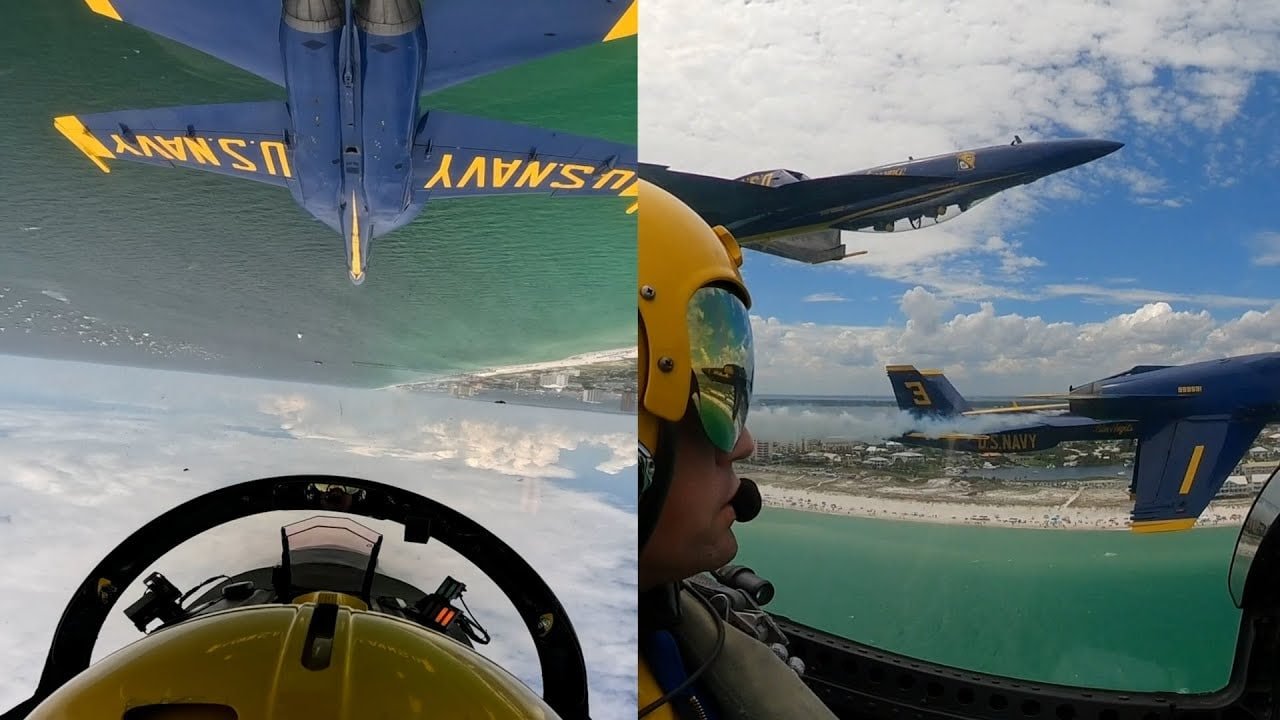
I thought about that again recently when a video clip of the Blue Angels went around the usual online circles. The one where the diamond formation is seen from inside the lead aircraft, the wingmen sitting close enough that their canopies appear to almost overlap, holding position at somewhere north of four hundred miles an hour. The comments, as they always are, were full of appropriately staggered admiration. But almost none of them touched on the thing that had been sitting in the back of my mind since that afternoon at Redhill.
At those speeds and that proximity, each aircraft is operating inside the aerodynamic influence of the others. The wingtip vortices off a fast jet at high thrust are not a polite inconvenience. They are a continuous rolling disturbance in the air mass, powerful enough to flip a light aircraft and demanding enough at the formation scale to require each Blue Angels pilot to hold a physical correction against them essentially the entire time. The slot pilot, tucked in below and behind the lead, is flying in disturbed air that does not behave the way undisturbed air does, which means their control inputs are being interpreted by an aircraft whose aerodynamic environment is in constant flux. They are not simply holding position. They are continuously solving a problem that keeps changing.
I have stood close enough to a tight formation pass at Biggin Hill to feel the pressure wave arrive slightly before the sound catches up, that odd physical thump against the chest that reminds you these are not things being performed at a comfortable distance. And I have read enough about display flying to know what the Blue Angels actually say, publicly, about their margins. Six feet of wingtip clearance in the diamond. Negative eighteen inches in the opposing solo manoeuvres, which is to say the aircraft are not merely close but are specifically flown to pass behind one another at positions calculated to be inside what visual judgment alone could reliably achieve. They are trusting geometry and rehearsal over real-time perception.
What they do not explain, because it does not serve the spectacle to explain it, is the degree to which the show you are watching from the ground is only possible because the pilots have essentially agreed, through months of incremental practice, to stop reacting in the way a human being naturally reacts to the proximity of another fast-moving object. The instinct to correct away from a threat has to be completely dismantled and replaced with learned stillness. The Blue Angels do not fly that close because proximity becomes comfortable. They fly that close because they have spent long enough doing it that the discomfort no longer triggers the wrong response.
That distinction matters more than it sounds. There is a tendency, and I see it at every airshow I attend, from the Fairford flight lines to the small grass-strip fly-ins that barely make the local paper, to present what display pilots do as a form of heightened natural gift. The commentary over the PA, the programme notes, even the pilots’ own public remarks tend toward a language of instinct and feeling. You do what feels right. After enough hours it becomes second nature. I understand why. It is a better story than the truth, which is that what you are watching is the systematic suppression of natural response through repetitive conditioning, applied to a physical environment that would kill an untrained pilot making untrained decisions.
The Blue Angels are brilliant. I am not diminishing the achievement. But the public conversation around what they do, and around close formation display flying generally, consistently aestheticises something that is actually a piece of applied psychology as much as it is aviation skill. The Redhill instructor did not tell me that formation flying felt natural once you got the hang of it. He said it never stops requiring active effort. You just get better at managing the effort without showing it.
That is what you are not seeing when you watch the diamond formation sit motionless in the English summer sky at Fairford, the aircraft apparently glued together by something other than physics. You are watching pilots work, continuously and invisibly, against forces the display has been designed to make look effortless.
The gap between what a display looks like and what it actually is has always been part of the contract between performers and crowd. I have just spent too long at too many airfields to pretend the gap is small.

Alex Bradley is a UK-based aviation writer and airshow circuit regular who has spent years attending displays from RIAT at Fairford and the Biggin Hill Festival of Flight to small fly-ins that drew two hundred people and a hot dog van, and values both for entirely different reasons.
He is not a pilot. He is not a PR man for the aviation industry. He is the person in the crowd who has been coming long enough to notice when something has quietly changed, when an organiser is papering over a problem, and when a display is genuinely worth the drive.
His writing on Redhill Airshow covers the British airshow circuit, safety, display team politics, CAA regulations, and the quiet contraction of grass airfield culture that nobody in the industry wants to discuss plainly.
He has stood at Redhill Aerodrome in every kind of English summer weather, watched Tiger Moths bank low over Surrey farmland, and carries strong opinions about what this country is slowly losing one cancelled event at a time.