
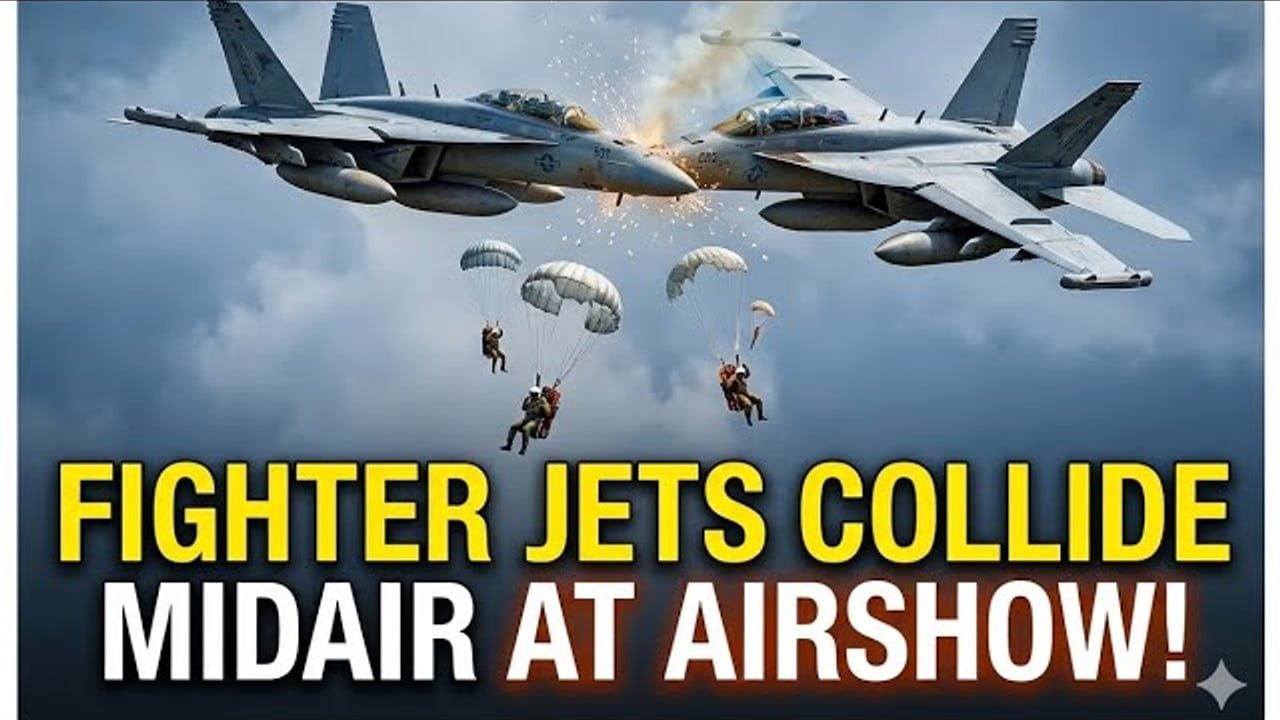
The ejection seat came out at about two thousand feet. I know that because I had been watching the display closely enough to judge the altitude, which is something you do after enough years of standing in fields looking up. One moment there was a jet. Then there was a bang, or something that might have been a bang heard a half-second after I registered the canopy separating, and then there was a parachute.
The crowd around me did not know what to do with it.
Some people cheered. Not many, but some, because the sequence of events had looked to them like something intentional, like part of a choreography they had not quite understood but were prepared to applaud anyway. Then the aircraft hit the ground a long way beyond the display line, and the sound reached us a moment later, and nobody cheered after that.
I was at one of the larger shows, a July afternoon with the particular flat quality that English summer light develops around three o’clock when cloud has been building since midday. The avgas smell had been sitting over the field since morning, which at a show of that size you stop noticing within the first hour. The commentary team were very good at filling silence. They filled it then. Within seconds there was a voice telling us to remain calm, that the display would be pausing briefly, that the pilot had ejected safely. That last part was, to their credit, true. He came down in a field beyond the perimeter and walked away with injuries described, later, as minor.
The family in the grandstand seats to my right did not move for quite a long time.
I had noticed them earlier in the afternoon because the father had been lifting a small girl onto his shoulders for each display pass, which is the kind of thing you do when you want your child to see over the heads in front and also when you want them to have a story for school on Monday. She was wearing ear defenders that were slightly too large and kept slipping. He had been adjusting them between passes, this small absorbed act of looking after somebody. They had a fold-out picnic chair, a cool bag, and a programme with the day marked in pencil.
After the ejection, and after the PA voice had moved efficiently on to the next scheduled item, the father sat down. The girl was no longer on his shoulders. His wife had her hand on his arm. None of them spoke, as far as I could see, for several minutes.
The display continued. Another aircraft came through. The crowd recovered its rhythm, the way crowds do, because crowds are very good at recovering rhythm and very bad at knowing what to do when rhythm is wrong for even a moment.
What I have not been able to stop thinking about, not from that afternoon and not from any of the conversations since, is the specific nature of what that family had agreed to without knowing they had agreed to it. They had bought tickets. They had driven somewhere and parked and queued and found their seats and lifted a small girl onto a pair of shoulders. They had, in doing all of this, consented to the spectacle of a jet aircraft displaying at speed and at low altitude, to the noise and the fuel smell and the compression you feel in your chest on a close pass. They had not consented to watching someone’s life enter genuine danger twenty minutes into the afternoon’s schedule.
That distinction matters. Airshows sell proximity. The selling point, the thing that makes them different from watching a screen, is that the aircraft is real and close and the physics of it are apparent in a way that cannot be replicated through glass. That realness is also the thing that means when something goes wrong, it goes wrong in front of you, without warning, without a cut to anything else, without anyone having prepared you for the emotional weight of what you are about to see.
I have stood on a lot of grass at a lot of events and listened to commentary teams describe displays in ways that make the risk sound abstract. Something about wing loading and G forces and precision training and CAA display authorisations, all of which is true and none of which prepares a man adjusting his daughter’s ear defenders for the moment a canopy separates at two thousand feet over a Surrey field on a Tuesday in July.
The pilot was fine. That matters and I am glad of it. But the family did not know the pilot was going to be fine for quite a long time, and they processed that uncertainty in public, in a grandstand, surrounded by strangers, while the PA system moved briskly on to what was next.
Airshows do not talk about that. The pilot’s story gets told. The family’s afternoon does not.

Alex Bradley is a UK-based aviation writer and airshow circuit regular who has spent years attending displays from RIAT at Fairford and the Biggin Hill Festival of Flight to small fly-ins that drew two hundred people and a hot dog van, and values both for entirely different reasons.
He is not a pilot. He is not a PR man for the aviation industry. He is the person in the crowd who has been coming long enough to notice when something has quietly changed, when an organiser is papering over a problem, and when a display is genuinely worth the drive.
His writing on Redhill Airshow covers the British airshow circuit, safety, display team politics, CAA regulations, and the quiet contraction of grass airfield culture that nobody in the industry wants to discuss plainly.
He has stood at Redhill Aerodrome in every kind of English summer weather, watched Tiger Moths bank low over Surrey farmland, and carries strong opinions about what this country is slowly losing one cancelled event at a time.