
I had been standing in the same spot for forty minutes when the Blue Angels came through for their opposing solos, and the man beside me, a retired RAF engineering officer whose name I never got but whose knowledge of aircraft systems I had been quietly testing for an hour, simply said nothing. Not awe, not the sharp intake of breath that crowds usually produce at that particular moment. Just silence. He watched the two F/A-18s pass each other at a combined closure rate that my brain declined to properly process, and then he turned back to his programme as though filing the information away somewhere it would require further consideration. I understood exactly what he meant by that, and neither of us said another word about it for several minutes.
I saw the Blue Angels for the first time at an air show in Maryland on a trip that had been ostensibly about other things, and I saw the Thunderbirds the following summer at a base event somewhere outside Phoenix that I had attached myself to through a contact who had access I did not strictly deserve. I have now seen both teams enough times that I can tell you something about them that the official programmes and the breathless aviation press coverage tends to leave out entirely, which is that the rivalry between them is real, it is old, it is occasionally pointed, and it tells you rather more about American military culture than either team’s public affairs operation would prefer.
The Thunderbirds are Air Force. The Blue Angels are Navy and Marine Corps. That distinction sounds administrative until you spend any time around the people involved, at which point it becomes the entire context for everything. The Air Force has always presented its team as precision embodied, geometric, exact, the demonstration of what happens when doctrine and training are applied with sufficient rigour. The Blue Angels have always presented theirs as something slightly less explicable, a tradition, a performance of naval aviation’s particular combination of aggression and elegance that goes back to 1946 and has never entirely decided whether it is a military demonstration or something closer to theatre.
I find the Thunderbirds easier to admire from a technical standpoint. The formations are tighter in some sequences. The brief is followed more visibly. There is a quality of mechanical repeatability to the best Thunderbirds performances that genuinely impresses me, the sense that you are watching something engineered as much as flown. At Redhill we see nothing like this of course, which is part of why I keep coming back here, where a Tiger Moth doing a gentle orbit in morning light and the smell of avgas drifting across damp summer grass constitutes its own form of aviation argument entirely. But I have stood at American military airshows and watched the Thunderbirds work and felt the way you feel watching a very good piece of manufacturing.
The Blue Angels do something different to me and I am not entirely comfortable saying this in public aviation circles because it sounds like the kind of thing people say about sports teams they have decided to prefer. But there is a quality to the best Blue Angels displays, something in the way the delta formation breaks apart and the solos begin their work, that does not feel repeatable in the same way. It feels like it is being done for the first time by people who know exactly what they are doing and have also never quite agreed to be predictable about it.
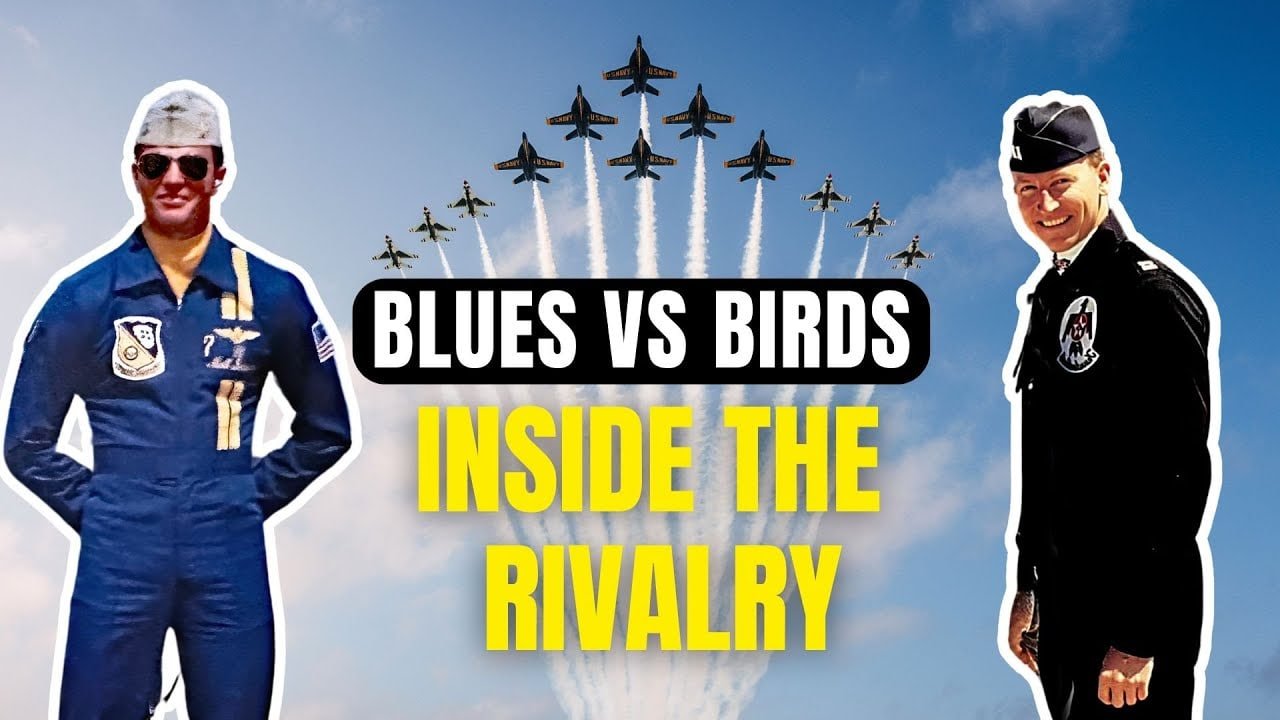
The thing that changed how I thought about all of this was a conversation I had with a public affairs officer attached to one of the two teams, and I will not specify which because I want to be honest rather than diplomatically vague, who told me something that I have been turning over since. He said that the rivalry was actively managed at a senior level, meaning that there were people in both organisations whose informal job included ensuring that the comparison never became too direct in public, because direct comparison would invite a conclusion, and a conclusion would create a loser, and a loser would create a budget argument. The two teams exist partly in opposition to each other, but they exist together because together they justify expenditure that neither could justify alone.
I found this clarifying in a way I had not expected. It explained the odd diplomatic language that both teams always use when asked directly about the other, the carefully constructed mutual respect that never quite says anything. It explained why the coverage of both teams in American aviation media tends to sit in separate boxes, this team’s season, that team’s season, never the same sentence if it can be avoided.
And it reminded me, standing back at Redhill on a Tuesday morning watching a Harvard do a slow pass over the grass strip with the particular sound of a radial engine at low power, the sound that seems to come from somewhere earlier, that the best aviation displays I have seen have never been about what the institution wanted me to think. They have been about the thing in the sky.
Both teams are genuinely extraordinary. The honest question, which nobody in an official capacity will answer, is whether they exist to demonstrate excellence or to demonstrate budget allocation. Those are not the same demonstration, and the difference matters more than the rivalry.

Alex Bradley is a UK-based aviation writer and airshow circuit regular who has spent years attending displays from RIAT at Fairford and the Biggin Hill Festival of Flight to small fly-ins that drew two hundred people and a hot dog van, and values both for entirely different reasons.
He is not a pilot. He is not a PR man for the aviation industry. He is the person in the crowd who has been coming long enough to notice when something has quietly changed, when an organiser is papering over a problem, and when a display is genuinely worth the drive.
His writing on Redhill Airshow covers the British airshow circuit, safety, display team politics, CAA regulations, and the quiet contraction of grass airfield culture that nobody in the industry wants to discuss plainly.
He has stood at Redhill Aerodrome in every kind of English summer weather, watched Tiger Moths bank low over Surrey farmland, and carries strong opinions about what this country is slowly losing one cancelled event at a time.