
The Formation That Does Not Need to Try
I was at an event in Lincolnshire, a modest affair by the standards of the major shows, maybe three thousand people on a good count, when the Lancaster came over low enough that I could see the bomb aimer’s position clearly through the Perspex. The crowd had been politely attentive all afternoon, doing what British airshow crowds do, watching carefully, applauding at appropriate moments, forming orderly queues for tea. And then the Lancaster arrived with its two Spitfire escorts, and something happened to the atmosphere that I have never been able to describe with complete accuracy because it was not loud and it was not performative. It was quiet. A specific, collective quiet. An elderly man two people along from me removed his cap without appearing to decide to.
I have thought about that moment many times since.
The Battle of Britain Memorial Flight has been operating in its current form since 1973. In the decades since, it has appeared at hundreds of events, accumulated millions of spectators, and developed a reputation that operates almost entirely independently of whatever else is on the programme. You can have a show with a Typhoon, a Red Arrows slot, and a visiting F-16 from a NATO partner, and the BBMF will still be the act that people remember. Not because the flying is the most technically demanding. It is not. The Lancaster is not a display aircraft in the conventional sense. The formation asks nothing of you in terms of knowledge or prior interest. And yet it consistently produces a response that nothing else on the airshow circuit reliably matches.
The question of why this is the case is one that I find people reach for lazy answers to very quickly. The aircraft are iconic. The Battle of Britain was a defining moment. People feel a connection to that history. All of this is true and none of it is quite sufficient, because there are other iconic aircraft and other defining historical moments, and none of them do to a crowd what the Lancaster and its Spitfires do.
I think the real answer is more specific and slightly less comfortable. The BBMF works the way it does because it is the only act in British airshow culture that brings death into the arena openly and without apology. Not the abstraction of military capability, not the excitement of speed and noise, but actual death, specific and named. The Lancaster flew operations over Europe in which the aircrew mortality rate was, for extended periods, worse than that of infantry in the First World War. The people who flew those aircraft knew this. Many of them did not come back. The ones who did come back mostly did not talk about it extensively for the rest of their lives. The Memorial Flight exists because the RAF decided, correctly, that some things deserve to be kept flying and kept visible.
When the formation appears, that is what arrives with it. The crowd does not need to know the statistics to feel the weight. The aircraft carry it themselves.
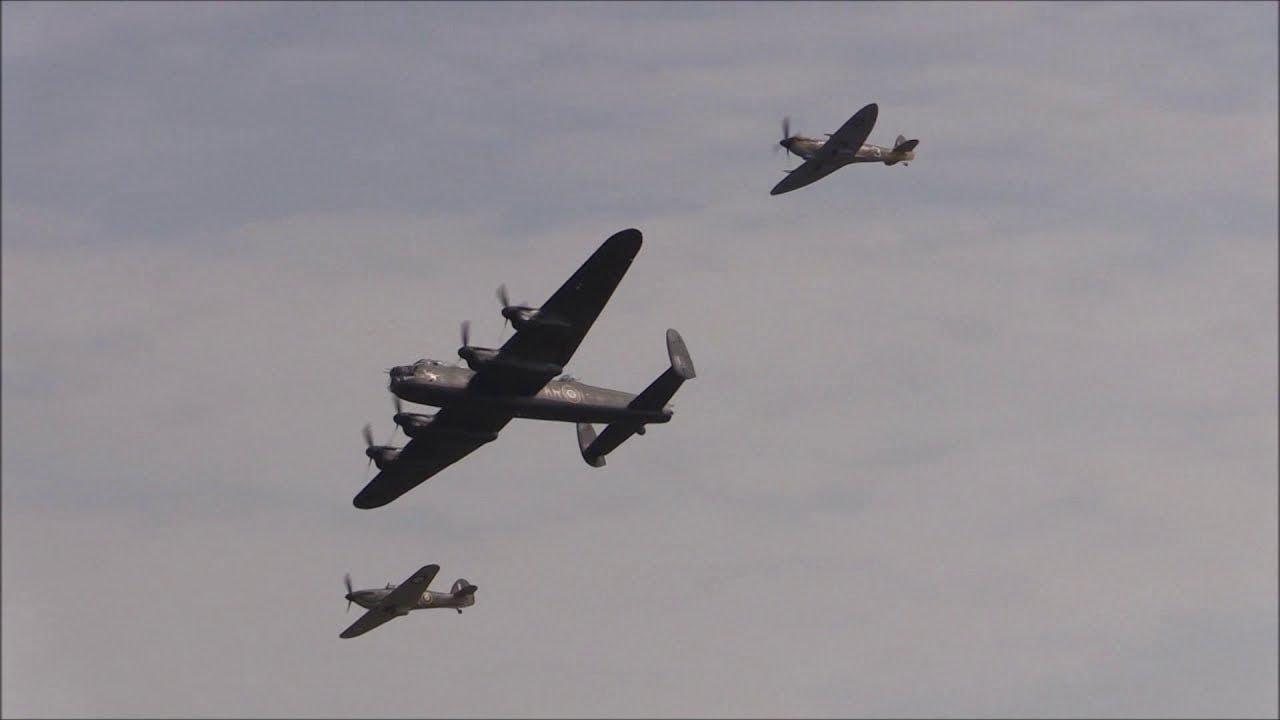
I was at a Biggin Hill show some years ago when the BBMF was late arriving due to a routing change, and there was a gap in the programme while people waited. The commentator filled time admirably. The crowd stood and watched the sky. When the sound of the Merlin finally came, heard before the aircraft were visible, which is always how it happens, always from somewhere behind you and to the left, the reaction was slightly out of proportion to what had actually occurred. People had been waiting for twenty minutes in warm sunshine and they were simply relieved. But the release in the crowd was bigger than relief. It had been accumulating. The waiting had done something to the quality of the attention.
The act does not manage this effect. It does not need to. It simply needs to arrive and fly a clean formation and let the weight of what the aircraft represent do what it has always done.
What I find genuinely interesting, and occasionally uncomfortable, is that the BBMF operates in a space that the airshow industry has not entirely honestly reckoned with. The emotional response it produces is so reliable and so significant that it has become something events use. The programming decision to put it late in the afternoon, when the light is going golden and flat and the crowd has been there long enough to feel the length of the day in their feet, is not accidental. The BBMF is, among other things, the act that ensures people feel the afternoon was worth attending, regardless of what else did or did not happen. I have been at shows where half the programme did not appear, for reasons that were dressed up as weather when they were clearly not weather, and the BBMF appearance at four o’clock papered over the afternoon’s failures so effectively that most people drove home satisfied.
That is a remarkable thing to be able to do. It is also, if you are inclined to be slightly cynical about it, a very useful thing for an organiser to have on the programme.
None of which diminishes what it actually is. The man who removed his cap in Lincolnshire was not responding to a programming decision. He was responding to something real.
That distinction is worth holding onto.

Alex Bradley is a UK-based aviation writer and airshow circuit regular who has spent years attending displays from RIAT at Fairford and the Biggin Hill Festival of Flight to small fly-ins that drew two hundred people and a hot dog van, and values both for entirely different reasons.
He is not a pilot. He is not a PR man for the aviation industry. He is the person in the crowd who has been coming long enough to notice when something has quietly changed, when an organiser is papering over a problem, and when a display is genuinely worth the drive.
His writing on Redhill Airshow covers the British airshow circuit, safety, display team politics, CAA regulations, and the quiet contraction of grass airfield culture that nobody in the industry wants to discuss plainly.
He has stood at Redhill Aerodrome in every kind of English summer weather, watched Tiger Moths bank low over Surrey farmland, and carries strong opinions about what this country is slowly losing one cancelled event at a time.