
I was standing near the rope at Duxford, maybe thirty feet from the runway threshold, when the Reds came back in from their transit and the lead aircraft went over at a height that briefly made conversation impossible. The smell hit first, that particular mix of jet exhaust and warm tarmac that does not smell like anything else in the world, and then the sound arrived properly, the kind that you feel in your chest rather than just hear. The nine Hawks were in close echelon, the wingtips stacked in that slightly improbable way that always looks photoshopped in pictures and completely, undeniably real from thirty feet. The woman next to me grabbed her husband’s arm without looking at him.
I thought about that moment last month when I read that the Red Arrows would be flying at an airshow in Michigan.
My first reaction, and I will be honest about this, was something close to pride. My second reaction, arriving about four seconds later, was a question I could not quite put down: why Michigan, and why now, and what exactly is this trip for?
The Red Arrows have toured internationally before. North America in 2019, various European appearances, diplomatic deployments that sit somewhere between pure aviation excellence and calculated national branding. None of that is new. But the framing around this particular visit, the language coming from the RAF press office and from the coverage that followed the announcement, carried a quality that I kept noticing and could not entirely ignore. Britain’s most famous flight team. Global ambassadors. Showcasing the best of British. The vocabulary of a country that is working quite hard to remind the world that it still has things worth noticing.
I do not think I am being uncharitable. Post-Brexit, Britain has been reaching for certain symbols with a frequency and a purpose that would have seemed excessive ten years ago, and the Red Arrows sit near the top of that list of symbols because they are genuinely impressive and because they require no explanation in any country with an airshow culture. You do not need to understand the politics of the 1960s formation aerobatics debate to know that nine aircraft flying that close together at those speeds represents something extraordinary. The Red Arrows work anywhere. That is precisely why they are being sent anywhere.
The question underneath all of this, and it is one I have been turning over for a while, is what the Michigan tour tells us about the state of the team’s position at home. The RAF’s relationship with its display assets is not straightforward. The Red Arrows cost money to operate, and the justification for that money has always rested on a combination of recruitment value, soft power value, and the simpler argument that a nation which invented the jet engine and produced the Spitfire ought to have a world-class aerobatic team as a basic cultural expectation. That argument has served the team well for decades. But arguments need to be renewed, and I have watched enough institutional decisions about airshow funding over the years to know that the renewal usually involves demonstrating relevance to an audience that has not recently been shown any.
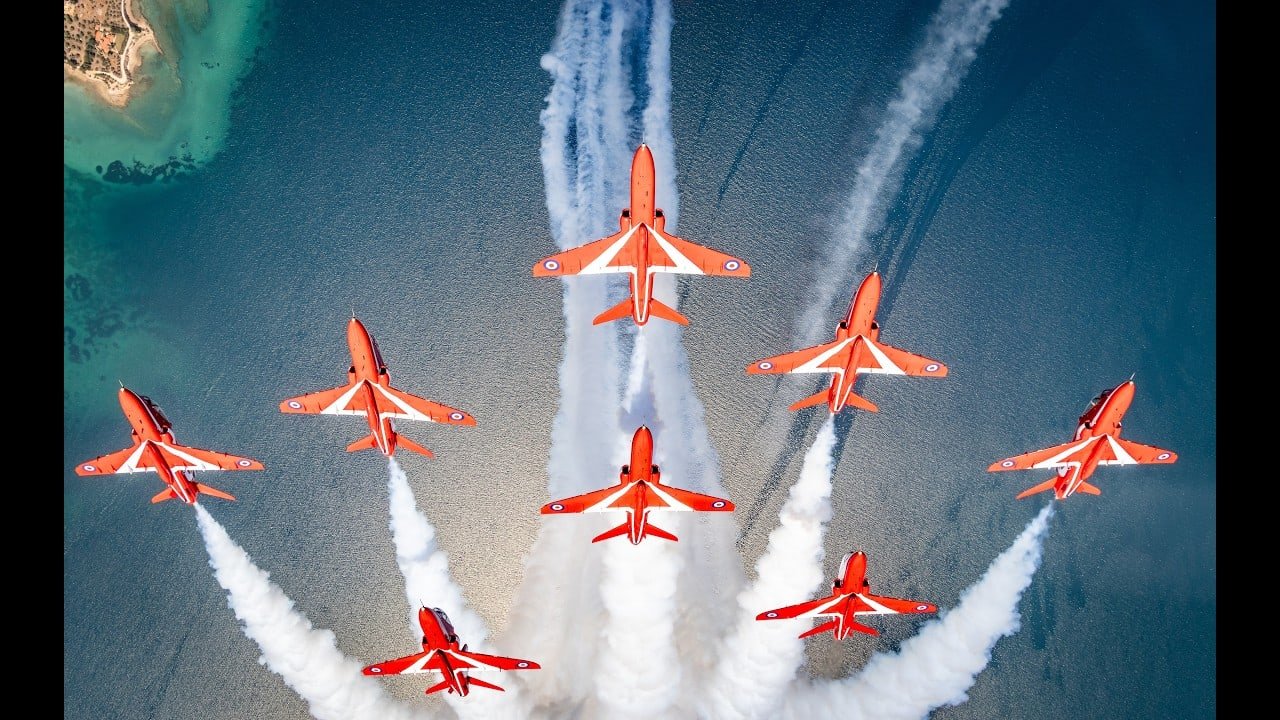
Michigan is part of demonstrating relevance. To whom, exactly, is the more interesting question.
The moment that shifted my thinking on this was not at a Red Arrows display. It was at a smaller event in the south of England, about two seasons ago, where I overheard two people from an events organisation discussing which aircraft they could realistically secure for the following year’s programme. The Red Arrows were mentioned, and then set aside fairly quickly, not because of disinterest but because the conversation around scheduling, lead times, and the team’s wider commitments had become complicated in ways that had not been true five years earlier. The team was simply harder to book than it used to be, and not because demand had decreased. The logistical and diplomatic obligations were accumulating in a direction that pointed outward rather than inward. I did not say anything. But I remembered it.
There will be people reading this who think I am being cynical about a straightforwardly good thing, and I want to push back on that slightly. The Red Arrows going to Michigan is not a bad thing. The Americans who see them will see something genuinely worth seeing, and some of them will become people who read about British aviation, who visit British airfields, who carry some version of that Duxford rope-line feeling around with them for years. I know what it means to see something in the sky that rearranges your sense of what is possible. The Reds do that to people.
But I am allowed to notice that British airshow culture has been quietly contracting for the better part of a decade, that events which existed ten years ago do not exist now, that organisers who would once have built a programme around a Red Arrows slot have stopped assuming that slot is available to them, and that the team’s international profile is growing at a moment when its domestic accessibility is, if anything, diminishing. Those two facts can coexist. They probably explain each other.
The Red Arrows belong, primarily, over British grass. The fact that they are increasingly found over foreign tarmac is worth thinking about honestly.

Alex Bradley is a UK-based aviation writer and airshow circuit regular who has spent years attending displays from RIAT at Fairford and the Biggin Hill Festival of Flight to small fly-ins that drew two hundred people and a hot dog van, and values both for entirely different reasons.
He is not a pilot. He is not a PR man for the aviation industry. He is the person in the crowd who has been coming long enough to notice when something has quietly changed, when an organiser is papering over a problem, and when a display is genuinely worth the drive.
His writing on Redhill Airshow covers the British airshow circuit, safety, display team politics, CAA regulations, and the quiet contraction of grass airfield culture that nobody in the industry wants to discuss plainly.
He has stood at Redhill Aerodrome in every kind of English summer weather, watched Tiger Moths bank low over Surrey farmland, and carries strong opinions about what this country is slowly losing one cancelled event at a time.