
It was a Thursday evening in August, and I had not gone to see a drone display. I had gone to a friend’s birthday gathering in a field in Wiltshire, which had, without adequate warning in the invitation, a drone show as part of the evening’s entertainment.
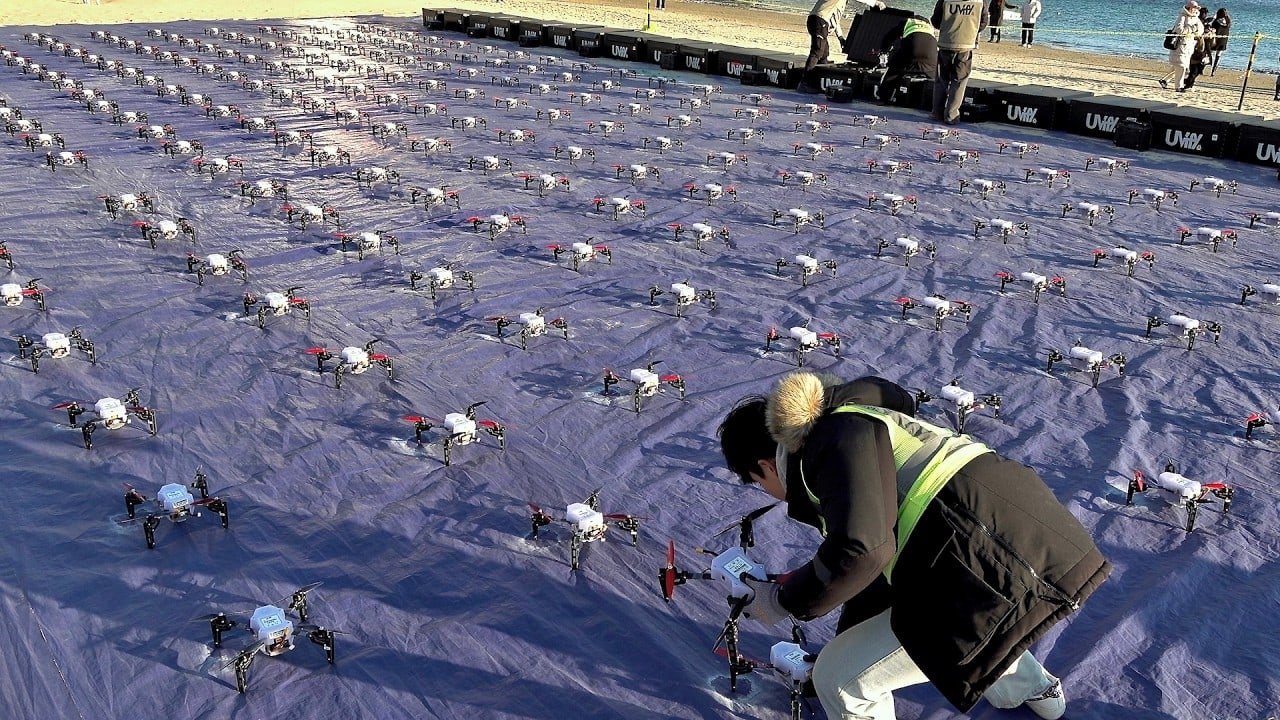
There were perhaps eighty of them. Small, LED-lit, operating in complete silence between moves and then with a high-frequency hum when climbing or turning that you felt more than heard. They formed shapes: a crown, a star, letters spelling something I did not retain because I was watching the formation transitions, the way a pattern of eighty individual objects could reorganise itself in three dimensions without collision, without hesitation, without a single element going to the wrong position.
It took me about four minutes to realise I was not finding it easy to look away.
This was the moment that changed something, and I have not finished working out what it changed. I had dismissed drone light shows, largely without having seen one properly, as corporate gimmickry: the sort of thing that functions at a product launch or a stadium concert and has nothing to do with the kind of aviation I actually care about. The smell of avgas and hot metal on a warm July morning, the damp grass under your boots after a night of rain, the sound of a Merlin that you hear before you see it and which does something physical to you before your brain has registered what the sound is. None of that is present in a drone display. None of it.
But something else is present, and I was not prepared for it. What it was, when I made myself identify it, was precision of a kind that human display flying cannot replicate, because human display flying is limited, by definition, by what a human body and a human nervous system can do inside an aircraft while remaining alive.
This is the sentence the airshow industry does not yet want to think about carefully. Drones do not experience G-force. They do not fatigue. They do not make the kind of perceptual error that occurs when a pilot has been flying a tight sequence in fluctuating English light for twenty minutes and their spatial reference shifts by a fraction. They do not have families waiting in the car park. When a drone display goes wrong, which happens, the consequences are a broken drone and a pause in the programme. When a human display goes wrong at the altitudes and margins that make display flying worth watching, the consequences are categorically different, and everyone on the crowd line knows this, whether or not they have consciously decided to know it.
The CAA has spent the last fifteen years steadily adjusting the parameters of what human display flying is permitted to do: raising minimums, increasing separation distances, tightening the conditions under which display authorisations are granted. These changes have, in each case, been described as proportionate responses to specific incidents or risk assessments. In most cases, I have no doubt, they have been exactly that. But the cumulative effect is a display environment in which what human pilots are permitted to show an audience has become progressively more conservative, at precisely the same time that drone technology has been developing without that same accumulation of regulatory restraint.
The result, which nobody in the airshow community is discussing with anything approaching honesty, is that within a reasonably short time, drone aerobatic displays will be operating within regulatory permissions that no human display team can match. They will fly lower. They will operate in tighter formations. They will perform manoeuvres that would be physically unsurvivable for a pilot and are merely a software parameter for a machine. And they will do all of this within frameworks that a regulator will find comfortable to approve, precisely because the human risk has been removed from the calculation.
I drove back from Wiltshire that evening thinking about Biggin Hill in the early nineties, before various things changed, and about a particular low-level fast jet pass I had watched once at an RAF station that I would very much like to see again and will not, because the conditions under which it was flown are no longer conditions a display authorisation will accommodate. I thought about the rope at Redhill, the marshal’s pointed finger, the way you can sometimes smell the oil as something old and impractical taxis past three metres away, and I tried to identify what it is about that transaction that a drone display does not, yet, provide.
The honest answer is: the danger. Or more precisely, the knowledge that something real is at stake, that the skill being demonstrated is deployed at a margin where error has a cost, and that the person inside the aircraft has chosen to operate at that margin in front of you. Remove the person, and you have removed the wager. A drone can do more. It risks nothing. And I am not entirely sure what an airshow is, once nothing is being risked.
That is the conversation the industry needs to have, and it is not having it.

Alex Bradley is a UK-based aviation writer and airshow circuit regular who has spent years attending displays from RIAT at Fairford and the Biggin Hill Festival of Flight to small fly-ins that drew two hundred people and a hot dog van, and values both for entirely different reasons.
He is not a pilot. He is not a PR man for the aviation industry. He is the person in the crowd who has been coming long enough to notice when something has quietly changed, when an organiser is papering over a problem, and when a display is genuinely worth the drive.
His writing on Redhill Airshow covers the British airshow circuit, safety, display team politics, CAA regulations, and the quiet contraction of grass airfield culture that nobody in the industry wants to discuss plainly.
He has stood at Redhill Aerodrome in every kind of English summer weather, watched Tiger Moths bank low over Surrey farmland, and carries strong opinions about what this country is slowly losing one cancelled event at a time.