
I counted them twice. Not because I doubted myself but because the part of my brain that has been watching the Red Arrows since I was old enough to stand at a fence and crane my neck refused to accept the number it kept arriving at. Seven. The diamond formation had a shape I did not recognise from the right angle and I stood there in the particular flat afternoon light that Fairford produces around four o’clock, tea gone cold in my hand, doing arithmetic that did not come out correctly no matter how many times I ran it.
This was two seasons ago now. The official communications at the time were careful and considered and said everything except the thing that needed saying. There had been attrition. There were aircraft availability questions. The engineering pipeline had pressures that were described in language that managed to be simultaneously specific and entirely uninformative. What was not said, in any official capacity, was that the most recognisable display team in Britain, the one that exists partly as a symbol of national capability and partly as a recruitment instrument and partly as a promise made to the public every summer for sixty years, was flying with a reduced formation because the resources required to maintain nine aircraft at display standard could no longer be reliably guaranteed.
I have been watching the Red Arrows long enough that I remember when the debate was about whether they should go to ten. That is not a boast. It is context.
The Gnats used to make a sound over Biggin Hill that I have never found an adequate description for, a wasp-in-a-tin quality that was entirely its own thing and that the Hawk replicated in a different register, lower, more authoritative, the kind of noise that you feel in your chest before your ears have fully processed it. The first time I heard a Hawk display at Redhill I was standing just inside the boundary and the aircraft was low enough that I could see the pilot’s helmet clearly and I understood in a way that is difficult to articulate why people who grew up near military airfields develop a relationship with this kind of noise that is not really about noise at all. It is about presence. The physical fact of a very capable machine operated by a very capable person doing something at the edge of what is possible. The Red Arrows have been the reliable annual delivery of that feeling to several million people across Britain for longer than most of their current audience has been alive.
Seven aircraft can produce a fine display. I want to be honest about that and not descend into the kind of complaint that is really just grief wearing the clothes of criticism. The pilots are extraordinary. The team’s professionalism has not diminished. What has diminished is something harder to quantify but no less real, which is the sense that the formation filling the sky is the formation it is because it is what was designed, not because it is what could be managed. Nine is not an arbitrary number. It produces symmetries and breaks and opposition manoeuvres whose geometry is specific to nine aircraft. Seven produces different geometry, some of it genuinely impressive, none of it the same. The audience largely does not know this. The audience sees the red jets and the smoke and feels the noise and responds in the way it has always responded. That is either heartening or troubling depending on how you look at it.
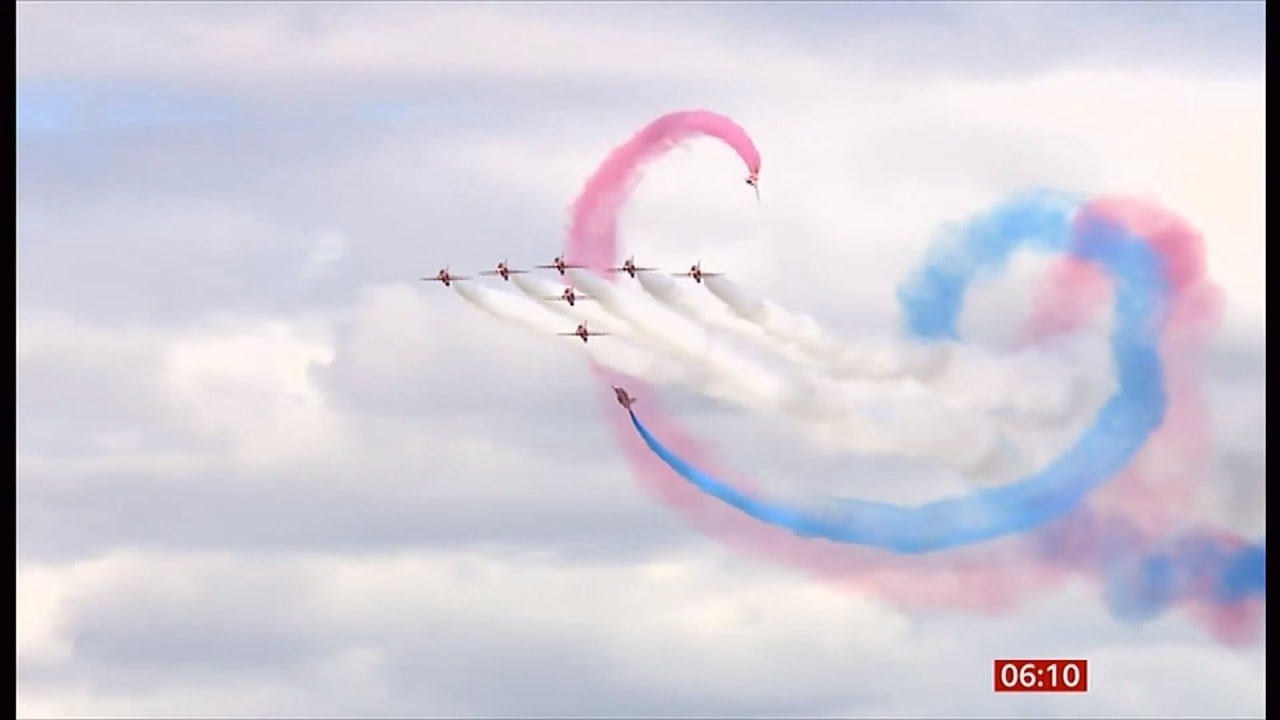
What changed my thinking was a conversation after a display at an event that I will not specify more precisely than that, with someone who works within the structure that supports the team rather than on it, who told me something that I had suspected but not confirmed. The reduced fleet was not a temporary adjustment pending resolution of an identifiable problem. It was a managed accommodation of a resource situation that had no clear near-term fix and that was being described publicly in terms designed to suggest the former while actually representing the latter. I have heard British airshow organisers describe weather-related cancellations in language borrowed from air traffic management. I have heard budget failures dressed as regulatory caution. The vocabulary of aviation administration is extremely well suited to obscuring the difference between a setback and a trajectory.
The Red Arrows’ problem is a trajectory problem. That is the thing that is not being said in public, and the not-saying of it does real damage, not to the team’s reputation, which remains intact, but to the possibility of an honest conversation about what it would take to reverse it. You cannot allocate resources to fixing a problem that has been officially described as a temporary inconvenience. The language creates the constraint.
I walked back to the car park at Fairford after those seven aircraft finished their display and I sat in the car for a moment before I turned the engine on. The grass had been damp since the previous evening’s rain and I had that particular English summer feeling of damp trouser bottoms and cold tea and something genuinely beautiful recently witnessed, and I did not quite trust it in the way I usually do.
The Red Arrows are not in crisis. They are in something more insidious than crisis, which is a slow adjustment downward that is being normalised one season at a time, and the only way it ends well is if someone with the authority to reverse it decides to say honestly what is actually happening first.

Alex Bradley is a UK-based aviation writer and airshow circuit regular who has spent years attending displays from RIAT at Fairford and the Biggin Hill Festival of Flight to small fly-ins that drew two hundred people and a hot dog van, and values both for entirely different reasons.
He is not a pilot. He is not a PR man for the aviation industry. He is the person in the crowd who has been coming long enough to notice when something has quietly changed, when an organiser is papering over a problem, and when a display is genuinely worth the drive.
His writing on Redhill Airshow covers the British airshow circuit, safety, display team politics, CAA regulations, and the quiet contraction of grass airfield culture that nobody in the industry wants to discuss plainly.
He has stood at Redhill Aerodrome in every kind of English summer weather, watched Tiger Moths bank low over Surrey farmland, and carries strong opinions about what this country is slowly losing one cancelled event at a time.