
The first time I saw an ejection seat demonstration — not a live one, mercifully, just a ground-based pyrotechnic test at a trade day at Farnborough — I remember thinking how extraordinarily violent the thing looked. The seat didn’t rise so much as detonate upward. A mannequin in a flight suit, gone in a fraction of a second, trailing smoke. The man beside me, a retired RAF engineer, watched it with the expression of someone doing mental arithmetic. “People don’t understand what that does to a spine,” he said, and then walked off to get a sandwich.
I have been thinking about that moment since the news came through about the Blue Angels incident at an American airshow, where four pilots ejected from their F/A-18s during a display sequence that went wrong in ways that are still being officially characterised. Four ejections. Over a crowd. The Navy called it a success because all four pilots survived. And I understand the logic of that framing, I genuinely do, but I also think it is one of the most revealing sentences the military-airshow complex has produced in some time.
Let me be clear about something before I go further. I am not writing this from a position of anti-airshow sentiment. I have stood on the Redhill grass on a warm June morning with avgas hanging in the air and watched a Spitfire turn onto finals close enough to see the exhaust staining on the cowling, and I have felt something that I cannot easily put into words and would not insult by trying. I have driven to Fairford at half past five in the morning and stood in a muddy field for eight hours and thought it was entirely worth it. I care about this. Which is exactly why I am not going to pretend that calling four emergency ejections over a public crowd a success story is a satisfying conclusion.
What strikes me most is the framing. The Navy’s position is technically defensible: the ejection seats worked, the pilots lived, the safety systems performed as designed. From a pure engineering standpoint that is genuinely not nothing. Ejections at low altitude during high-energy manoeuvres carry a real probability of fatality, and the fact that all four men survived is a testament to decades of seat development. But the question being quietly avoided is how four pilots came to need those seats simultaneously, at an airshow, above a crowd of several thousand people who had paid to be there.
British airshow culture has its own uncomfortable relationship with this territory. We have had our incidents. Shoreham in 2015 changed the regulatory landscape in ways that were necessary but that also, if I am being honest, sometimes feel as though they were designed more to protect institutions from liability than crowds from risk. I have stood at events since then and watched display envelopes that felt so conservative as to make certain aircraft look almost inert, and I have also attended grass-strip fly-ins where the informality of the setting created a proximity to aircraft that no post-Shoreham risk assessment would sanction at a licensed display site. The tension between those two experiences has never really been resolved. It has just been managed differently depending on who is doing the paperwork.
What happened at this American event forces a question that both the US Navy and, by extension, British display authorities would prefer to approach obliquely: what is the actual risk tolerance we are setting when we authorise high-performance military fast jet displays over dense crowds? Not the theoretical risk tolerance written into the operations manual. The actual one, revealed by what we permit and how we talk about it when it goes wrong.
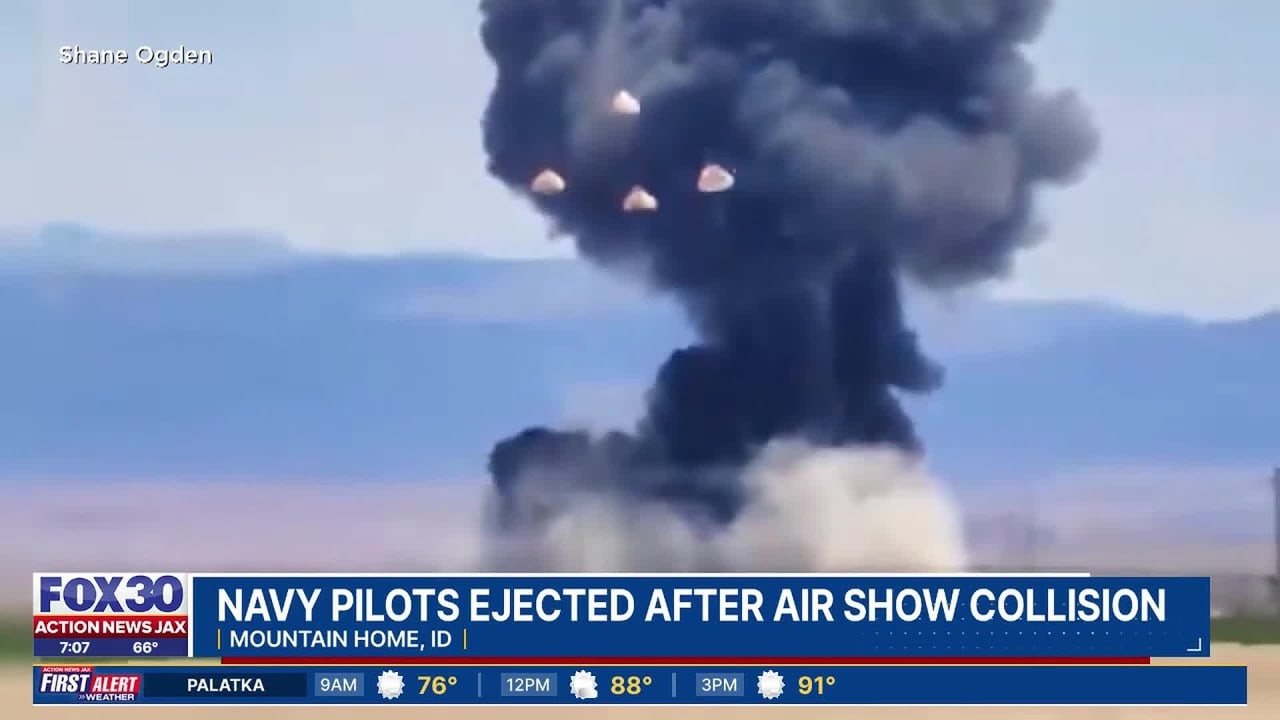
Four ejections is not a success story with a silver lining. It is a near-catastrophe in which the catastrophe was avoided by equipment functioning correctly under extreme stress. That is different. The crowd on the ground had no say in that distinction, and they were close enough that the outcome of a slightly different set of variables would have been measured in mass casualties. The fact that we are reading about survival rather than fatalities is fortunate. Luck and success are not the same thing, and an institution with the Navy’s communication resources knows the difference better than anyone.
There is something I notice at smaller British events that I have always found more honest than the big station open days. When something goes wrong at Redhill, or at one of the quiet little fly-ins in the Home Counties, the organisers tend to just say so. A display pilot who had to pull out of his sequence because the conditions changed will often walk over and explain it to whoever is standing nearby. There is no press release. There is no institutional framing. There is just a man in a flying suit explaining, with some frustration, what the afternoon actually looked like from the cockpit. I trust that. It sounds like the truth.
What I do not trust is the language that emerges when large organisations face embarrassing events and decide that the narrative is a problem to be solved rather than information to be shared honestly.
Four pilots ejected over a public crowd. They survived. That is genuinely good. The rest of it, what it means about the display sequence, the authorisation, the risk assessment, and the distance between institutional confidence and actual safety margin, is a conversation that has not yet happened in public.
It probably should.

Alex Bradley is a UK-based aviation writer and airshow circuit regular who has spent years attending displays from RIAT at Fairford and the Biggin Hill Festival of Flight to small fly-ins that drew two hundred people and a hot dog van, and values both for entirely different reasons.
He is not a pilot. He is not a PR man for the aviation industry. He is the person in the crowd who has been coming long enough to notice when something has quietly changed, when an organiser is papering over a problem, and when a display is genuinely worth the drive.
His writing on Redhill Airshow covers the British airshow circuit, safety, display team politics, CAA regulations, and the quiet contraction of grass airfield culture that nobody in the industry wants to discuss plainly.
He has stood at Redhill Aerodrome in every kind of English summer weather, watched Tiger Moths bank low over Surrey farmland, and carries strong opinions about what this country is slowly losing one cancelled event at a time.