
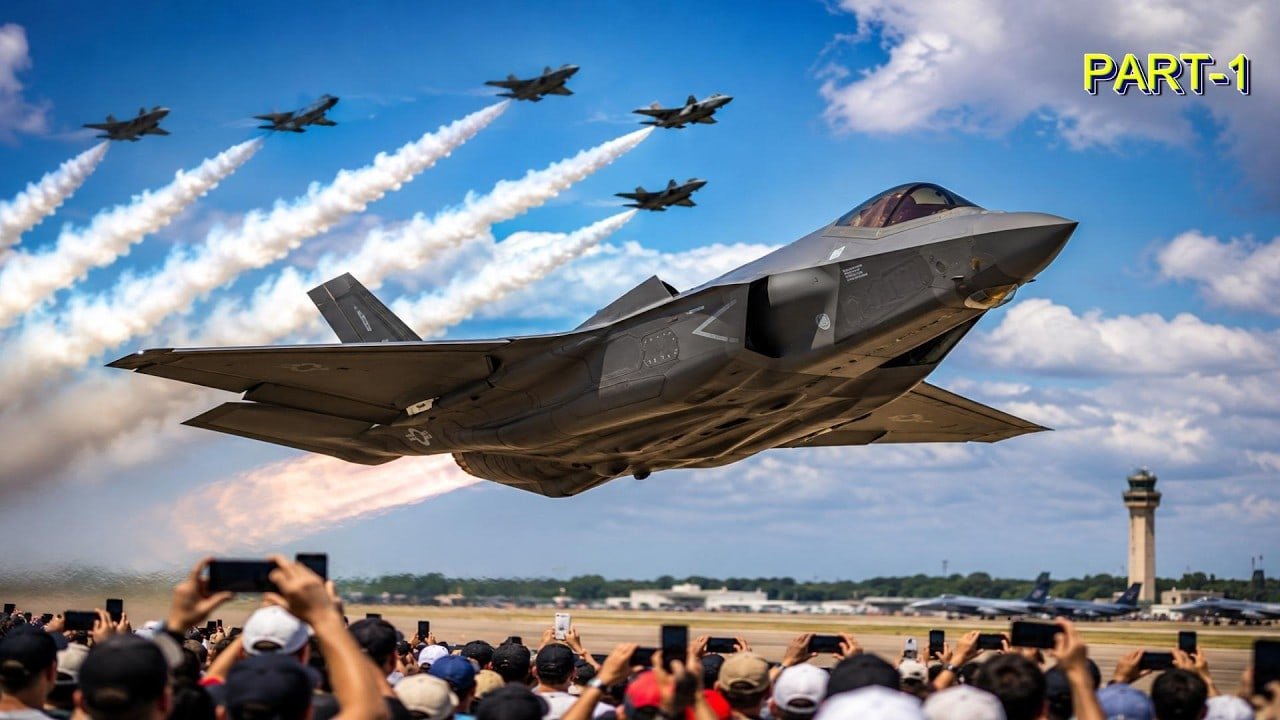
I heard the F-22 before I had any reasonable right to. The sound arrived somewhere over the tree line to the west of the display line, a low registered pressure rather than anything you could call a noise yet, and then it was overhead and the sound caught up to it and the physical sensation of that much thrust at that proximity is not something you process intellectually in the moment. You just absorb it. The woman beside me at the fence grabbed her husband’s arm without apparently noticing she had done so. I have been to enough displays to know that reaction is not about fear. It is about scale. The aircraft is simply too large a fact to receive calmly at close range.
That was Lakenheath, an American show on a British base, which exists in a slightly odd category of its own. But it gave me my clearest recent comparison point for what the American airshow circuit actually feels like versus what we tend to produce on this side of the Atlantic, and the difference is not simply one of resources or military hardware, though both of those are real. The difference is one of intention.
American airshows are designed to overwhelm. This is not a criticism. It is a design philosophy, executed deliberately and with considerable skill. The crowds at the larger American events, Oshkosh, Thunder Over Michigan, the big base shows, run to numbers that would require most British venues to fundamentally rethink their ground infrastructure, and they keep growing. The 2023 figures from several major American shows were the highest recorded in their histories, which is remarkable given that those shows were already very large and that they are competing against an entertainment landscape that has never offered more alternatives.
What is interesting, and what I have been turning over since reading some of the American coverage of this growth, is that the audience expansion has happened alongside, and in some cases apparently because of, a period in which American display flying has pushed its risk envelope in ways that the post-Shoreham British regulatory environment has moved firmly away from. The crowds are not growing despite the danger. There is a reasonable argument that the sense of genuine proximity to genuine risk is part of what is drawing them.
I find this uncomfortable to say plainly, because the honest version of it is that a portion of any airshow audience, in any country, is drawn by the same thing that draws people to motorsport. Not the hope that something will go wrong. But the knowledge that it could. The visceral reality of that possibility is part of what makes the experience different from watching a film about aircraft.
The moment this clarified for me was not at a display at all. It was a conversation I had at Biggin Hill some years ago with a man who had been attending airshows since the 1970s and had watched the British circuit contract and moderate itself through successive regulatory tightening. He was not angry about it. He was precise about it. He said that what had been lost was not the aircraft or even particularly the manoeuvres, but the sense that you were in the presence of something that had not been entirely sanitised. That the display you were watching existed in the same physical world you were standing in rather than behind an invisible membrane of managed distance.
He was describing something that the American shows have retained and that significant portions of the British circuit have not, and the crowd figures on both sides of the Atlantic suggest that this is not a trivial distinction.
I am not arguing that the British regulatory response to Shoreham was wrong. I am not qualified to make that argument and the losses involved prohibit flippancy. What I am arguing is that the conversation that followed Shoreham, about what an airshow is and what it is permitted to be, was had almost entirely within the industry and the regulatory framework and almost not at all with the audience that was being asked to accept a changed experience. The CAA consulted, in the sense that consultation documents were issued and responses were solicited. But the public dialogue about what British airshow culture was losing and what it might gain and whether the trade was correctly calibrated was, essentially, not had.
Meanwhile the American shows grew. The crowds kept coming. The displays kept pushing at the edges of what is considered acceptable proximity and energy, and the incidents that have resulted, several of them serious, have not produced the regulatory contraction that comparable British incidents produced. Whether that represents a different risk philosophy or simply a different political economy of regulation is a question that deserves more honest examination than it currently receives in either country.
At Redhill on a calm Sunday morning the aircraft are close enough that you can hear the pilot adjusting power and the smell of avgas on warm air is uncomplicated and the whole thing feels nothing like a performance managed at a considered distance. It feels like being at an aerodrome. That sounds like a small thing. In the current British context, it is becoming a rarer one.
The American crowds keep growing because the American shows keep feeling like something that is actually happening, rather than something that has been carefully arranged to look like something that is actually happening.
That distinction is worth sitting with for a while.

Alex Bradley is a UK-based aviation writer and airshow circuit regular who has spent years attending displays from RIAT at Fairford and the Biggin Hill Festival of Flight to small fly-ins that drew two hundred people and a hot dog van, and values both for entirely different reasons.
He is not a pilot. He is not a PR man for the aviation industry. He is the person in the crowd who has been coming long enough to notice when something has quietly changed, when an organiser is papering over a problem, and when a display is genuinely worth the drive.
His writing on Redhill Airshow covers the British airshow circuit, safety, display team politics, CAA regulations, and the quiet contraction of grass airfield culture that nobody in the industry wants to discuss plainly.
He has stood at Redhill Aerodrome in every kind of English summer weather, watched Tiger Moths bank low over Surrey farmland, and carries strong opinions about what this country is slowly losing one cancelled event at a time.