
There is a particular quality to the silence that follows something that should not have happened. Not the absence of noise. Something denser than that. I have been trying to find the right description for eighteen months and I am not sure I have it yet, but it is the silence of several thousand people arriving simultaneously at the same realisation and not yet having the language for it.
I was at Mountain Home Air Force Base in Idaho for a display that had been on my list for two years. Proper front-row position, the kind you earn by arriving early and standing in heat that by eleven in the morning was doing things to the flight line tarmac that made it look liquid at the edges. The F-15s had been working through their programme with the particular aggression that Mountain Home crews are known for, and I had been watching with the focused attention I bring to a display I have specifically travelled for, noting the formation geometry, the timing on the break manoeuvres, the way the afterburners caught the Idaho light differently from anything I had seen over an English airfield.
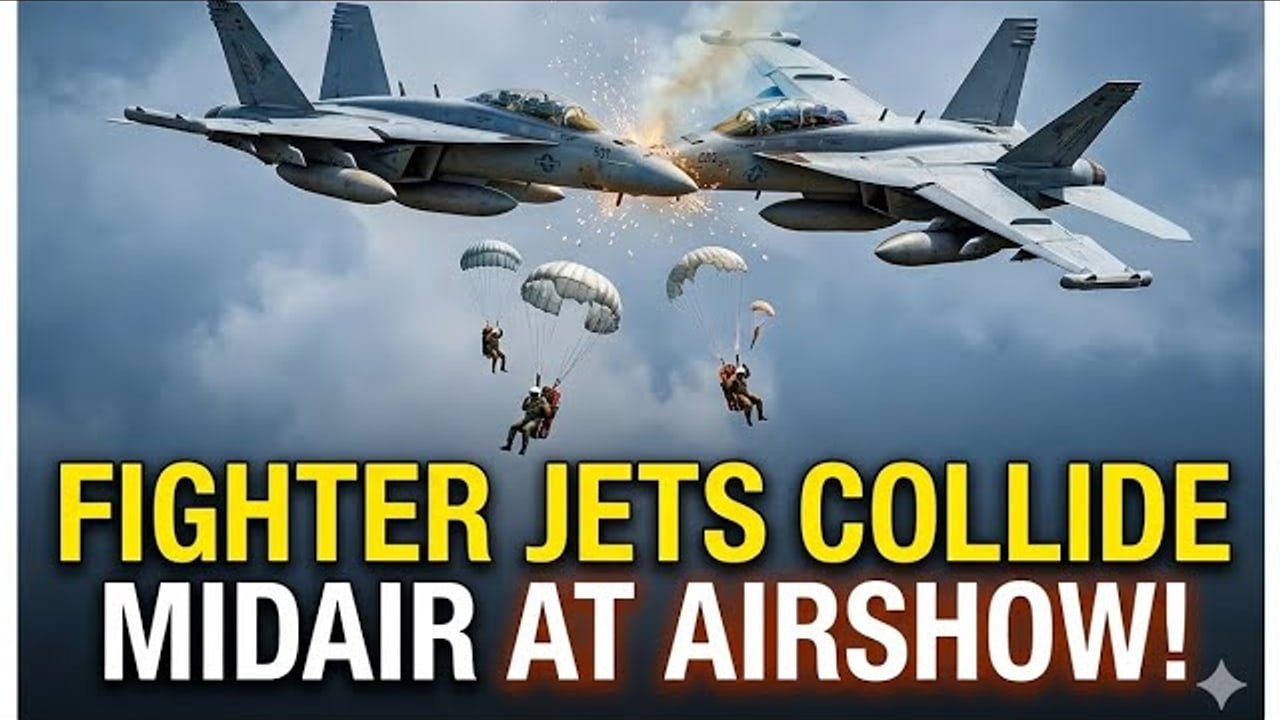
Then the two aircraft were in the same piece of sky in a way that the programme had not suggested they would be, and then they were not, and then the silence arrived.
I want to be precise about what I actually saw because I have noticed in the coverage since that there is a tendency to reach for the most dramatic possible framing, and I think that tendency, while understandable, does a disservice to what actually happens in these moments. What I saw was contact. A clipping of wingtip on fuselage at a moment when the geometries of two high-speed aircraft had resolved to a point that the pilots had not intended and the crowd had not expected. Both aircraft continued flying. That matters and I will return to it. But in the moment, from where I was standing, what I had was impact and smoke and a sound that my brain filed under entirely the wrong category for approximately three seconds before the correct category became unavoidable.
Both pilots got their aircraft down. One at the base, one as an emergency at a secondary field. Both survived. I did not know any of that for some time. What I knew, standing in the front row while the PA system produced sounds that were clearly improvised by someone whose training had not quite prepared them for this specific situation, was that I had watched two military jets collide above a crowd and I was not certain what was still in the air or where it was going.
The subsequent investigation found contributing factors that I am not going to relitigate here because I do not have access to the full picture and I am not a flight safety analyst. What I will say is that the post-incident communications from the base public affairs operation were among the most carefully managed I have encountered in twenty years of attending displays, and I mean that in the specific and uncomfortable sense that carefully managed communications and complete transparency are not always the same product.
I have been back at Redhill twice since Mountain Home. The first time I sat in the plastic chairs outside the clubhouse and watched a Piper Cub do a gentle departure into a grey Surrey morning and felt something that I can only describe as disproportionate relief. Not the pleasure I usually feel at Redhill, that unhurried garden-party sense of aircraft and grass and people who know what they are looking at. Something rawer. The kind of gratitude for ordinary things that tends to arrive after an experience has recalibrated what ordinary means.
The second time I was more myself, and I was able to think more clearly about what Mountain Home had actually changed in me, which is not my appetite for airshows and not my belief in the skill of military display pilots, both of which remain intact. What it changed was my patience for the gap between what display organisers say about safety and what they actually do about it. That gap exists at every level of British and American airshow culture, from RIAT down to a two-hundred-person fly-in with a hot dog van and a marshal with a hi-vis vest, and I had known it existed before Idaho. What I had not done, until I stood in that silence on a flight line in the American west and felt the ground stay solid under my feet while everything above it was briefly unclear, was feel the gap rather than simply observe it.
The thing that stays with me is not the collision itself. It is the three seconds before I understood what I was looking at, when my brain was still running its normal subroutines, still filing incoming information under known categories, still assuming that the display I was watching would resolve the way displays resolve. That assumption is the thing that no safety brief has ever actually addressed, because the safety brief is addressed to the pilots and the organisers, and the person standing in the front row is not part of the safety plan in any meaningful sense. They are the reason the event exists. They are also, in most frameworks I have encountered, the last thing anyone accounts for.
I do not know what that means in terms of what should change. I am genuinely uncertain, which is not a position I occupy comfortably. What I know is that the silence after Mountain Home was a different kind of knowing, and I have not managed to unfeel it.

Alex Bradley is a UK-based aviation writer and airshow circuit regular who has spent years attending displays from RIAT at Fairford and the Biggin Hill Festival of Flight to small fly-ins that drew two hundred people and a hot dog van, and values both for entirely different reasons.
He is not a pilot. He is not a PR man for the aviation industry. He is the person in the crowd who has been coming long enough to notice when something has quietly changed, when an organiser is papering over a problem, and when a display is genuinely worth the drive.
His writing on Redhill Airshow covers the British airshow circuit, safety, display team politics, CAA regulations, and the quiet contraction of grass airfield culture that nobody in the industry wants to discuss plainly.
He has stood at Redhill Aerodrome in every kind of English summer weather, watched Tiger Moths bank low over Surrey farmland, and carries strong opinions about what this country is slowly losing one cancelled event at a time.