The 1952 Farnborough Airshow crash occurred on 6 September 1952 at the Royal Aircraft Establishment Farnborough, Hampshire, England. A prototype de Havilland DH.110 disintegrated mid-air during a display in front of approximately 120,000 spectators, killing 31 people — 2 crew members and 29 spectators — and injuring 60 others. It remains one of the most consequential aviation accidents in British airshow history.
For official aviation safety context, see the UK Civil Aviation Authority. For the previous guide in this series, see Waddington Airshow 2026: Why It Was Cancelled and the 4 Best UK Alternatives to Attend.
What Happened at the 1952 Farnborough Airshow?
The 1952 Farnborough Airshow was an annual aviation event organised by the Society of British Aircraft Constructors (SBAC) at the Royal Aircraft Establishment, Farnborough, Hampshire. The show was a major platform for British aviation manufacturers to demonstrate prototype and production aircraft to military buyers and the public.
On 6 September 1952, during the afternoon flying programme, the de Havilland DH.110 prototype WG236 broke apart in flight at approximately 450 knots (830 km/h) while performing a high-speed manoeuvre. The aircraft disintegrated in under 1 second. Debris fell across the spectator area, killing 29 people on the ground.
When and Where Did the Crash Occur?
|
Detail |
Information |
|
Date |
6 September 1952 |
|
Time |
Approximately 3:45pm |
|
Location |
Royal Aircraft Establishment, Farnborough, Hampshire, England |
|
Aircraft |
De Havilland DH.110, registration WG236 |
|
Spectators present |
Approximately 120,000 |
|
Crew fatalities |
2 |
|
Ground fatalities |
29 |
|
Ground injuries |
60 |
|
Total fatalities |
31 |
Who Was Involved in the 1952 Farnborough Airshow Crash?
The aircraft carried 2 crew members: pilot Squadron Leader John Douglas Derry DFC and flight test observer Anthony Richards.
Who Was Pilot John Derry?
Squadron Leader John Douglas Derry DFC (5 December 1921 – 6 September 1952) is widely regarded as the first British pilot to exceed the speed of sound in a British aircraft. He was 30 years old at the time of the 1952 crash.
Derry’s record-breaking career included the following:
- 6 September 1948 — He conducted a supersonic dive in a de Havilland DH 108 Swallow from 40,000 feet (12,195m), reaching estimated speeds above Mach 1. This occurred exactly 4 years before his death.
- 1947 — He joined de Havilland as a test pilot after serving as a Hawker Typhoon pilot with 182 Squadron from 1944, flying close support missions in the Low Countries
- 1948 — He was awarded the Gold Medal of the Royal Aero Club
- He developed the Derry Turn, an aerobatic manoeuvre consisting of a bank reversal performed with the aircraft passing through the inverted attitude, which is named in his honour
Derry had also flown the DH.110 supersonically over the same airshow on its opening day, making the 6 September demonstration a continuation of an already high-profile programme.
Who Was Flight Test Observer Anthony Richards?
Anthony Richards was 25 years old and a graduate member of the Royal Aeronautical Society. He had joined de Havilland as an apprentice and became a member of the flight-test section in December 1948.
In April 1952 — 5 months before the crash — Richards became the first British flight test observer to exceed the speed of sound, with Derry as the pilot.
What Aircraft Was Involved in the 1952 Farnborough Crash?
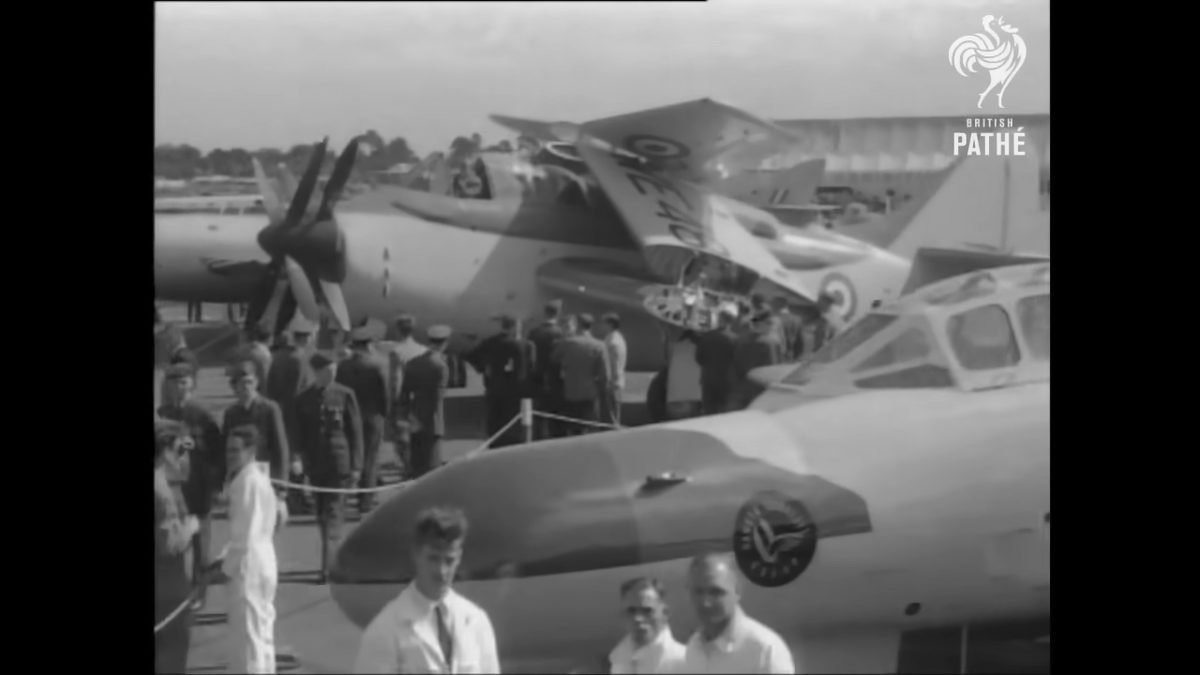
What Was the De Havilland DH.110?
The de Havilland DH.110 was a prototype all-weather interceptor designed for the Fleet Air Arm of the Royal Navy. It was a 2-seat, twin-engine, swept-wing jet fighter capable of supersonic speed, powered by 2 Rolls-Royce Avon engines.
The aircraft that crashed — registration WG236 — was the first DH.110 prototype. It made its first flight on 26 September 1951 and had accumulated approximately 125 hours of flight time at the time of the accident.
The original aircraft scheduled for the 6 September display was WG240, the second prototype. WG240 became unserviceable on the day. Derry and Richards collected WG236 from the de Havilland factory in Hatfield, Hertfordshire, and flew it to Farnborough as a replacement.
How Did the 1952 Farnborough Airshow Crash Happen?
The display began at approximately 3:45pm. Derry initiated a supersonic dive from 40,000 feet (12,000m), pulling out below the airfield altitude. He then conducted a high-speed, low-level circuit of the airfield.
Heading toward the crowd at approximately 450 knots (830 km/h) in a left bank, Derry pulled the DH.110 into a climb. At that point:
- The outer section of the starboard (right) wing broke off
- The outer section of the port (left) wing broke off immediately after
- The sudden shift in the aircraft’s centre of pressure caused it to pitch violently upward
- The cockpit section, both engines, and the tailplane were torn from the airframe
- The complete disintegration occurred in less than 1 second
The cockpit section fell close to the runway in front of the nearest spectators. Both engines, each weighing over 1 tonne, were projected on a ballistic trajectory. 1 engine landed without causing casualties. The second engine struck Observation Hill — the main spectator mound — causing the majority of ground fatalities.
What Caused the 1952 Farnborough Airshow Crash?
What Did the Official Investigation Find?
The official accident report was published on 8 April 1953. It identified the primary cause as the structural failure of the starboard wing’s leading edge skin, which possessed only 64% of its intended strength.
The investigation found that:
- The D-nose leading edge arrangement used on the DH.110 had been adapted from the lighter, subsonic de Havilland Vampire
- The structure was insufficient to withstand the high-G aerodynamic loads generated by the heavier DH.110 at transonic and supersonic speeds
- The combination of turning and straightening the aircraft created an airframe instability that the wing structure could not sustain
The coroner’s jury recorded that Derry and Richards had died accidentally in the normal course of their duty. The jury confirmed that the spectator deaths were accidental and that no blame was attached to John Derry.
What Were the Consequences of the 1952 Farnborough Crash?
What Safety Changes Did the Crash Bring to UK Airshows?
The 1952 crash produced the most significant revision of UK airshow safety regulations in the event’s history. New rules enacted after the crash required the following minimum separation distances:
- 230m (750ft) from spectators when flying in a straight line
- 450m (1,480ft) from spectators when performing manoeuvres
- A minimum display altitude of 150m (490ft) at all times
Following these changes, no spectators were killed at a British airshow for 63 years — until the 2015 Shoreham Airshow crash, in which 11 people died.
What Happened to the DH.110 After the Crash?
All DH.110 aircraft were initially grounded following the accident. After significant redesign to the wing structure, the aircraft resumed flights in June 1953. The type was subsequently developed into the de Havilland Sea Vixen, a naval fighter that entered operational service with the Royal Navy and served until 1972.
Notably, the airshow did not stop on the day of the crash. After the debris was cleared from the runway, the flying programme continued. Test pilot Neville Duke exhibited the prototype Hawker Hunter and took it supersonic over the show later that same afternoon.
How Is the 1952 Farnborough Airshow Crash Remembered Today?
For 69 years, the civilian casualties of the 1952 crash had no formal memorial. On 6 September 2021 — the 69th anniversary — a memorial consisting of 32 bricks, each inscribed with the name of the airshow and the names of the 31 casualties, was unveiled at the Farnborough Air Sciences Trust Museum in Hampshire.
Queen Elizabeth II and Duncan Sandys, the Minister of Supply, both sent messages of condolence following the 1952 crash.
The 1952 film The Sound Barrier, directed by David Lean, drew direct inspiration from de Havilland test pilots including John Derry, dramatising the challenges of breaking the sound barrier in Britain’s early jet research era.
The 1952 Farnborough Airshow crash is the defining event in the history of UK airshow safety regulation and directly shaped the crowd-separation standards that govern British air displays to this day.

Alex Bradley is a UK-based aviation writer and airshow circuit regular who has spent years attending displays from RIAT at Fairford and the Biggin Hill Festival of Flight to small fly-ins that drew two hundred people and a hot dog van, and values both for entirely different reasons.
He is not a pilot. He is not a PR man for the aviation industry. He is the person in the crowd who has been coming long enough to notice when something has quietly changed, when an organiser is papering over a problem, and when a display is genuinely worth the drive.
His writing on Redhill Airshow covers the British airshow circuit, safety, display team politics, CAA regulations, and the quiet contraction of grass airfield culture that nobody in the industry wants to discuss plainly.
He has stood at Redhill Aerodrome in every kind of English summer weather, watched Tiger Moths bank low over Surrey farmland, and carries strong opinions about what this country is slowly losing one cancelled event at a time.