The Shoreham Airshow disaster occurred on 22 August 2015, when a vintage Hawker Hunter T7 jet aircraft crashed onto the A27 road in West Sussex during an aerial display, killing 11 people and injuring 16 others. It was the deadliest airshow accident in the United Kingdom since the 1952 Farnborough Airshow crash, which killed 31 people. This article covers the sequence of events, the official investigation findings, the legal proceedings, and the regulatory changes introduced as a result.
For official aviation safety context, see the UK Civil Aviation Authority. For the previous guide in this series, see Shuttleworth Airshow 2026: 7 Shows, Full Season Dates, Aircraft, and Everything Visitors Need to Know.
What Was the Shoreham Airshow Disaster?
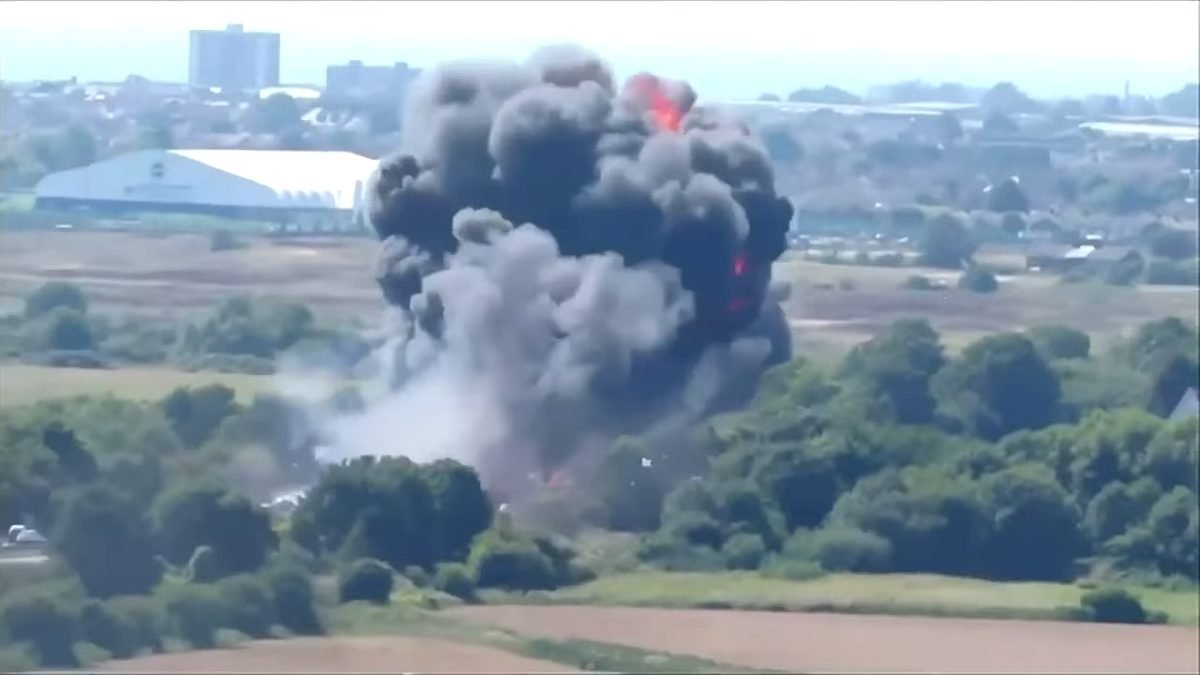
On 22 August 2015, a Hawker Hunter T7 warbird crashed onto a main road during an aerial display at the Shoreham Airshow at Shoreham Airport, England, killing 11 people and injuring 16 others. The aircraft failed to complete a loop manoeuvre and crashed, hitting vehicles on the A27 road adjacent to the airport. The pilot, Andy Hill, was critically injured but survived.
As a result of the accident, all civilian-registered Hawker Hunter aircraft in the United Kingdom were grounded, and restrictions were placed on civilian vintage jet aircraft displays over land, limiting them to high-level flypasts and banning aerobatic manoeuvres.
Who Were the 11 Victims of the Shoreham Airshow Disaster?
All 11 victims were local men from Sussex. They were Anthony Brightwell, 53, from Hove; Daniele Polito, 23, from Goring-by-Sea; Dylan Archer, 42, from Brighton; Jacob Schilt, 23, from Brighton; James Mallinson, 72, from Newick; Mark Reeves, 53, from Seaford; Mark Trussler, 54, from Worthing; Matthew Grimstone, 23, from Brighton; Matthew Jones, 24, from Littlehampton; Maurice Abrahams, 76, from Brighton; and Richard Smith, 26, from Hove.
Many of the victims were not attending the airshow. Several were travelling on the A27 when the aircraft came down. Maurice Abrahams, 76, was on his way to collect a bride for her wedding in his Daimler, having served in the Grenadier Guards and the Parachute Regiment. Mark Reeves, 53, had ridden his motorcycle to photograph the airshow when he was caught in the incident.
The crash represented the largest civilian loss of life in the United Kingdom since the 7 July 2005 London bombings, and the first fatalities on the ground at any UK airshow since 1952.
What Caused the Shoreham Airshow Disaster?
What Did the AAIB Investigation Find?
The UK Air Accidents Investigation Branch (AAIB) concluded that pilot Andy Hill crashed after commencing a “bent loop” manoeuvre with insufficient speed and engine thrust to complete it within the height available. According to the pilot’s own display plan, a minimum apex height of 3,500ft was required to execute the manoeuvre safely, but investigators found that the Hunter achieved only between an estimated 2,700ft and 2,950ft.
The AAIB identified 4 specific contributing factors:
- The manoeuvre commenced from a lower height — around 185ft, rather than the 500ft mandated for a Hunter.
- The aircraft began its climb at 310 knots — 40 knots below the minimum planned value.
- Maximum engine thrust was not reached or maintained during the climb.
- The pilot had not received formal training to escape from the accident manoeuvre in a Hunter and had not practised the technique for escaping from the manoeuvre before the display.
The AAIB final report stated that the aircraft appeared to be working properly but that the pilot entered the manoeuvre too low and too slowly, and did not take a possible escape action when things went wrong. This may have been because he did not, or possibly could not, read the altimeter, misread it, or did not remember the correct height for that type of aircraft.
Was There a Regulatory Failure at the Shoreham Airshow?
Yes. The AAIB found conflicting views over who was responsible for the safety of the display and the onlookers. The Civil Aviation Authority (CAA) believed the organisers of the Shoreham Airshow owned the risk, while the organisers said the CAA was the gatekeeper of all safety and risk management relating to air displays. The 220-page final report stated: “No organisation or individual considered all the hazards associated with the aircraft’s display, what could go wrong, who might be affected and what could be done to mitigate the risks.”
The AAIB safety report confirmed that there were several events that contributed to the accident: regulatory confusion about who was in charge of risk, a risk assessment that was not suitable, and the pilot entering the aerobatic manoeuvre too slow and pulling out of the apex turn at too low a height.
The AAIB published a total of 32 safety recommendations across its special bulletins and final report. The CAA accepted all recommendations. Work is now complete on all items.
What Were the Legal Proceedings After the Shoreham Disaster?
Was the Pilot Charged?
In 2018, Hill was charged with 11 counts of manslaughter by gross negligence and one count of endangering an aircraft. He was found not guilty on all counts on 8 March 2019.
What Did the Inquest Conclude?
In December 2022, 7 years after the crash, the coroner ruled that the victims were unlawfully killed. The coroner described Hill’s flying as “exceptionally bad” and the airshow’s safety plan as “not fit for purpose.”
West Sussex Senior Coroner Penelope Schofield stated it was “clear and obvious” that Hill should have abandoned the manoeuvre he was undertaking, adding: “This was not a close or difficult judgment call.”
In February 2023, Hill applied to the High Court for permission for a judicial review of the inquest conclusion, but his application was refused. His pilot licences were revoked on the grounds of both competence and fitness of character, and his final appeal for review of that decision was denied in May 2025.
What Safety Changes Followed the Shoreham Airshow Disaster?
The Shoreham disaster produced the most significant restructuring of UK airshow safety regulation in modern history. Many enhanced safety measures were introduced and new procedures put in place in response to the AAIB’s recommendations, including:
- Fitness assessments — introduced for display pilots, display pilot evaluators, and Flying Display Directors.
- Risk assessment reviews — now required as part of the Flying Display Permission issuing process.
- Vintage jet restrictions — on 24 August 2015, the CAA imposed restrictions on vintage jet aircraft performing over land at airshows, reducing displays to flypasts only.
- Grounding of Hawker Hunters — all civilian-registered Hawker Hunter aircraft in the United Kingdom were grounded following the accident.
- Increased organisational costs — regulations for airshows were significantly tightened by the CAA, increasing costs to organisers to fund the new safety measures to a degree that led to the cancellation of later shows.
The Senior Coroner stated that in light of the comprehensive safety recommendations made by the AAIB and their subsequent implementation by the CAA, she did not consider it necessary to make any additional report for the prevention of future deaths.
What Memorial Exists for the Shoreham Airshow Victims?
In March 2017, Adur District Council announced that a series of sculptures were to be placed along the banks of the River Adur as a memorial. In May 2019, a permanent memorial was erected near the Shoreham Tollbridge.
The old toll bridge near the accident site became a focus of community grief in the days after the crash, with more than 7,000 people coming to the bridge in Shoreham to light candles, with people queuing in the rain for more than an hour.
Has the Shoreham Airshow Returned?
As of February 2025, no further Shoreham Airshow has taken place or been announced. The Shoreham disaster fundamentally reshaped airshow safety culture across the United Kingdom. The 32 AAIB safety recommendations implemented by the CAA remain the foundation of current UK civil airshow regulation, and the Shoreham crash is referenced in pilot training and display authority assessments across the country.
If you are a family member of one of the 11 victims and require support, contact the Sussex Community Foundation at sussexgiving.org.uk.

Alex Bradley is a UK-based aviation writer and airshow circuit regular who has spent years attending displays from RIAT at Fairford and the Biggin Hill Festival of Flight to small fly-ins that drew two hundred people and a hot dog van, and values both for entirely different reasons.
He is not a pilot. He is not a PR man for the aviation industry. He is the person in the crowd who has been coming long enough to notice when something has quietly changed, when an organiser is papering over a problem, and when a display is genuinely worth the drive.
His writing on Redhill Airshow covers the British airshow circuit, safety, display team politics, CAA regulations, and the quiet contraction of grass airfield culture that nobody in the industry wants to discuss plainly.
He has stood at Redhill Aerodrome in every kind of English summer weather, watched Tiger Moths bank low over Surrey farmland, and carries strong opinions about what this country is slowly losing one cancelled event at a time.